
Criminal Court Records in Lowndes County
A criminal court record is the court-maintained case file opened when criminal charges are filed or transferred into court. It differs from a sheriff booking record, which documents custody, arrest, bond, and jail status. For custody details, the Lowndes County inmate records path is more direct. For formal charges, pleas, dispositions, and sentencing, the court case file is the better source.
Superior Court handles felony prosecutions in Lowndes County. State Court handles misdemeanors, traffic misdemeanors, and related non-felony criminal matters. Magistrate Court handles arrest warrants after probable cause, first appearances, bond hearings, preliminary hearings, pre-arrest warrant hearings, ordinance hearings, and truancy matters. Valdosta Municipal Court can handle city ordinance, municipal traffic, environmental, housing, nuisance, business, and some state-law violations.
The office path changes with the case stage. A new arrest may be easiest to confirm through jail and bond records. A pending felony prosecution belongs in Superior Court records after filing. A misdemeanor or traffic misdemeanor may appear in State Court. A missed municipal citation may remain with Valdosta Municipal Court until it moves into a different status.
How to Search Lowndes County Criminal Court Records
The local online starting point is the Lowndes County Odyssey Portal, linked from the county's Electronic Court Offerings page. The county says Odyssey provides case, calendar, party, register-of-actions, judgment, order, docket, and calendar information. For a complete or certified copy, contact the Clerk of Superior Court / Clerk of Court at 327 N. Ashley St., 1st Floor, Valdosta, or call 229-333-5127.
- Open the Lowndes County Odyssey Portal and choose Smart Search for the case search.
- Search by defendant name, business name if applicable, or case number when known.
- Review court level, case type, filing date, parties, and docket activity to confirm the correct case.
- Open the record entries for charges, pleas, motions, hearings, disposition, sentencing, and orders.
- Request a clerk copy if the portal does not show the needed document or if a certified criminal disposition is required.
For broader Georgia criminal-history information, the Georgia Bureau of Investigation criminal-history FAQ explains statewide criminal-history access and record restrictions. GBI material is not the same as the Lowndes court case file. A criminal-history report can summarize arrest and disposition information, while the Clerk of Court file is the record source for local case filings, orders, and certified court documents.
The GBI record-restriction page explains how Georgia treats restricted criminal-history information.
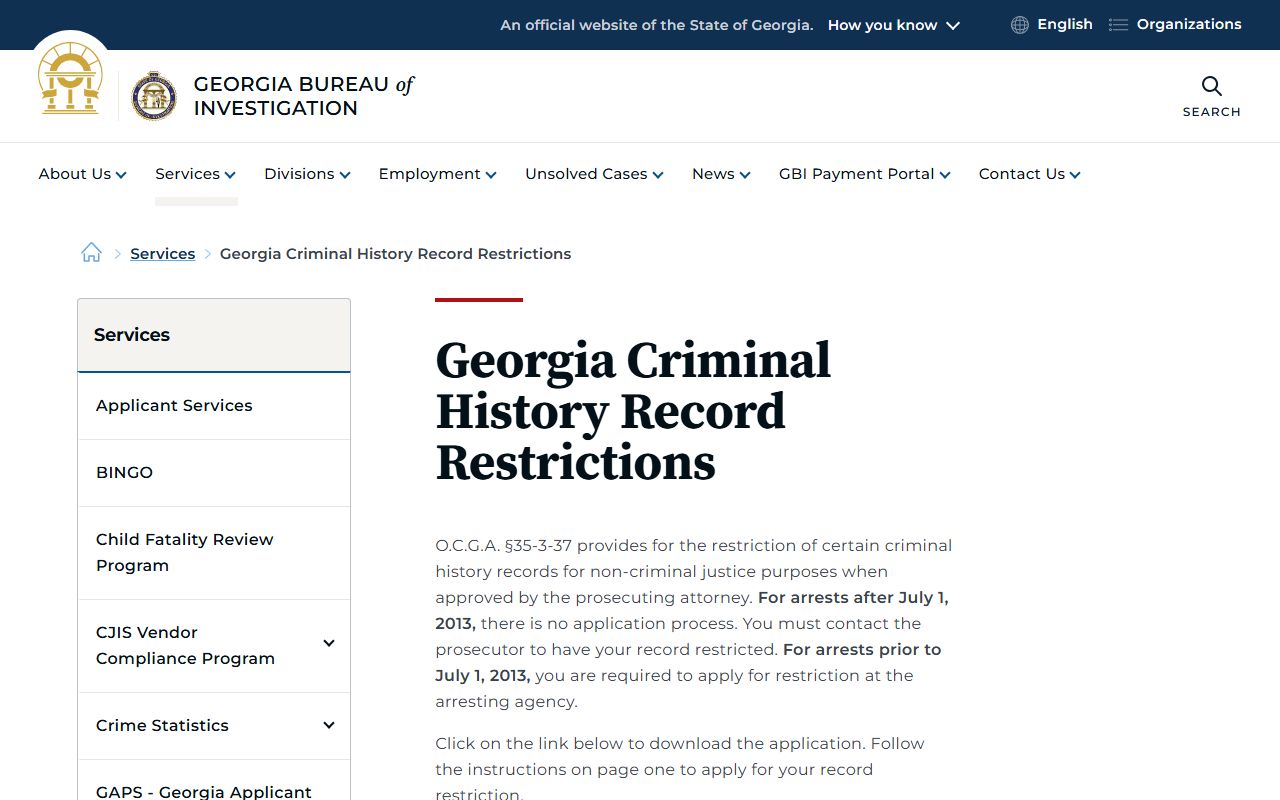
That statewide process is important for Lowndes criminal records because a restricted criminal history and a visible court docket are related but not always identical.
Stages of a Criminal Case
Criminal cases move through a sequence that may begin with an arrest, warrant, accusation, indictment, or citation. The court record grows as each event is filed or heard. Magistrate Court may appear early through warrants, first appearances, bond hearings, and preliminary hearings. Superior or State Court then carries the main prosecution depending on felony or misdemeanor jurisdiction.
Case flow: Charges Filed › Arraignment › Pretrial / Motions › Plea or Trial › Disposition › Sentencing
| Stage | What Happens |
|---|---|
| First Appearance / Bond | Rights, custody status, bond, and early conditions may be addressed, often after a warrant or arrest. |
| Arraignment | The defendant is formally called on the charge and enters a plea such as guilty, not guilty, or nolo contendere. |
| Pretrial / Motions | Attorneys file motions, discovery issues are raised, hearings are set, and the docket records orders and continuances. |
| Plea or Trial | The case resolves through plea, trial verdict, dismissal, acquittal, or other disposition. |
| Sentencing | The court records jail, probation, fines, restitution, treatment, license consequences, or other sentence terms when imposed. |
What a Lowndes County Criminal Court Record Shows
Criminal court records usually combine docket activity with charge and disposition data. The Lowndes Odyssey description includes case, calendar, party, register-of-actions, judgment, order, docket, and calendar information. A full clerk file may also include accusations, indictments, warrants, bond orders, plea forms, sentencing orders, probation entries, revocation filings, and appeals.
| Field | What It Shows |
|---|---|
| Case Number | The court's criminal case identifier, citation number, or related warrant or docket number. |
| Defendant | The person charged, with public identifiers subject to redaction. |
| Charges | Offense names, statute references, severity level, count numbers, and amended or dismissed charge activity. |
| Plea | The defendant's plea, including guilty, not guilty, or nolo contendere when entered. |
| Disposition | The final outcome for each charge, such as guilty, dismissed, acquitted, nolle prosequi, or other resolution. |
| Sentence | Jail, probation, fine, restitution, treatment, revocation, or other conditions ordered by the court. |
| Hearings | Arraignment, motion hearings, trial settings, plea hearings, sentencing, revocation, and continuances. |
The GBI criminal-history FAQ is a statewide source for criminal-history access limits.
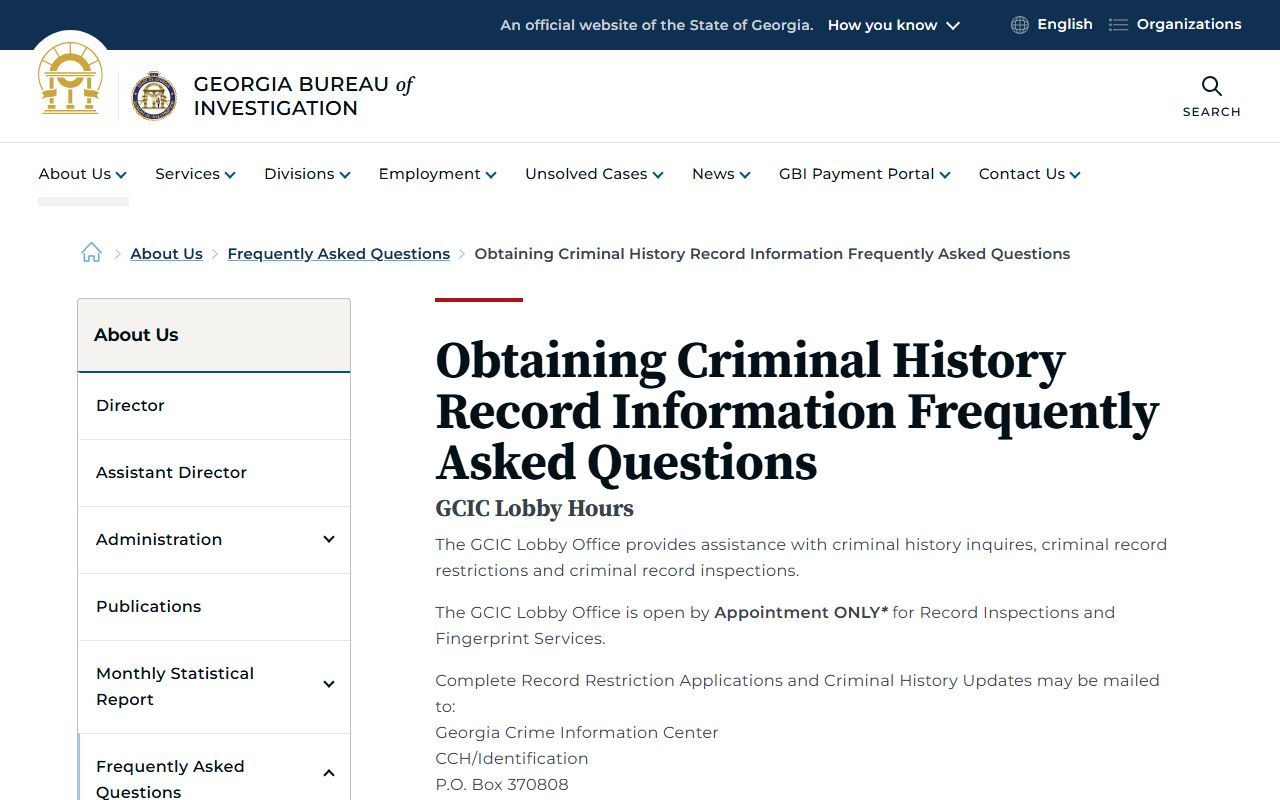
Use GBI materials for statewide criminal-history questions, and use Lowndes court and clerk channels for case-specific filings, dockets, and certified dispositions.
Charges vs. Convictions
A charge is an allegation or formal count. A conviction is a court outcome after a guilty plea, guilty verdict, or similar final adjudication. A Lowndes criminal court record can show charges that were later dismissed, reduced, amended, or resolved without conviction. For the narrower arrest-to-charge path, see arrest records and court charges.
| Charge | Conviction | |
|---|---|---|
| Stage | Accusation, indictment, citation, or formal count | Final plea, verdict, or adjudication |
| Proof Point | Probable cause or prosecutorial filing decision | Guilt established by plea or verdict |
| Public Record | Often public unless sealed, restricted, juvenile, or confidential | Often public unless sealed, restricted, First Offender, juvenile, or confidential |
Reading Dispositions and Sentences
Disposition means the final outcome of a charge or case. Guilty, not guilty, dismissed, nolle prosequi, acquitted, and plea-based outcomes can appear differently by case and court. Sentence means the punishment or conditions ordered after conviction or plea, which may include jail, probation, fines, restitution, treatment, community service, license consequences, or revocation terms.
Georgia First Offender Act cases require careful reading. O.C.G.A. Section 42-8-60 et seq. can allow eligible defendants to be sentenced without a final conviction, and successful completion can affect public access and criminal-history reporting. Revocation or noncompletion changes the result, so the docket and sentence order should be reviewed before treating a First Offender entry as a conviction or dismissal.
The Georgia Attorney General's First Offender Act opinion page provides background on Georgia first-offender treatment.
First Offender entries should be read against the actual Lowndes court order, because successful completion and revocation produce different record consequences.
Sealed vs. Restricted Records
Georgia commonly uses the term record restriction rather than expungement. Restriction can limit public access to criminal-history information for non-criminal-justice purposes, while a sealed court record is hidden from ordinary public viewing by law or court order. These are not the same as deleting every trace of a court case.
| Sealed | Restricted | |
|---|---|---|
| Visibility | Hidden from public access by law or court order | Limited for qualifying criminal-history access |
| Law Enforcement | May retain access under legal authority | Criminal-justice users may still see restricted information |
| Georgia Route | Court order or statute-driven confidentiality | O.C.G.A. Section 35-3-37 process tied to arrest date and disposition |
Public Access to Criminal Court Records
Georgia public access starts with the presumption in O.C.G.A. Section 50-18-70, while O.C.G.A. Section 50-18-71 addresses inspection, copying, and fee rules. Court files also follow judicial sealing rules, juvenile confidentiality, criminal-history restriction law, and redaction duties for protected identifiers.
Key Statutes:
O.C.G.A. Section 35-3-37 - Georgia's criminal-history record restriction law for qualifying arrests and dispositions.
O.C.G.A. Section 42-8-60 et seq. - Georgia First Offender Act provisions that can affect public conviction reporting after successful completion.
Background Check Considerations
A casual criminal court records lookup is not the same as an FCRA-compliant consumer report. Employers, landlords, insurers, lenders, and other regulated users must follow federal and state background-check rules, use appropriate screening providers, and account for record restrictions, dismissed charges, First Offender treatment, and case dispositions.
Important: Criminal case information should be verified with the originating court before use in any regulated decision.
The U.S. Attorney's Middle District of Georgia release involving a Lowndes County deputy is federal public-safety context, not a county case search tool.
Federal prosecutions and federal public-safety releases belong to the Middle District of Georgia record system rather than the Lowndes Odyssey portal.
Restricted Criminal Court Records in Lowndes County
Juvenile criminal-type matters are not ordinary public criminal dockets. Sealed cases, restricted criminal-history information, active investigations, adoption-related material, mental-health proceedings, and protected personal identifiers may also be unavailable or redacted. For arrests after July 1, 2013, GBI says the person generally contacts the prosecutor to pursue restriction. In Lowndes County, that may mean the District Attorney for felony/Superior Court matters or the Solicitor General for State Court misdemeanor matters.
The District Attorney's office is at 327 N. Ashley St., Valdosta, with phone 229-671-3268, and Bradfield M. Shealy is listed as District Attorney. The Solicitor General, Justo Cabral, handles State Court misdemeanor and traffic prosecution functions and is listed at 229-671-2510. The Public Defender at 910 N. Patterson St., 229-671-2800, represents eligible defendants in Superior and Juvenile Court, but it is not the public records custodian for criminal case files.
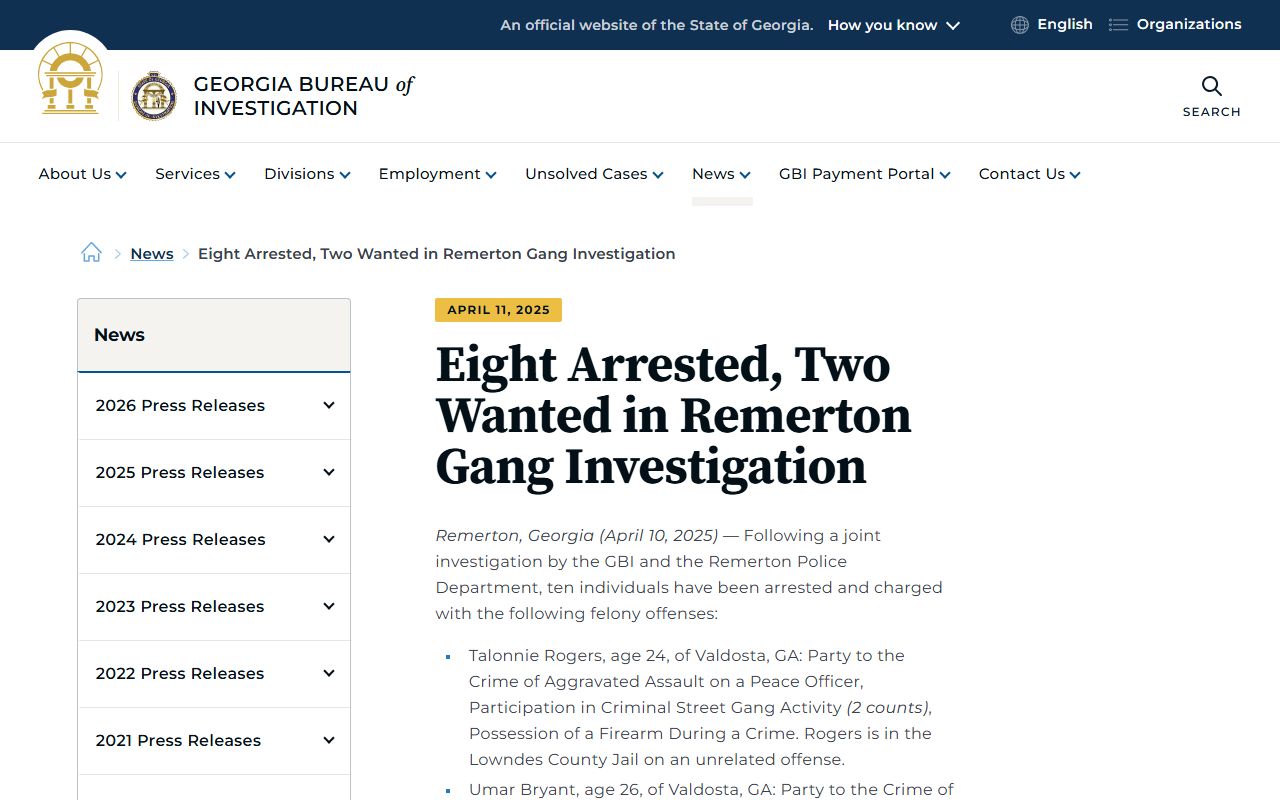
The GBI Remerton investigation release shows how local arrests and charges may involve state agencies, municipal police, and later court proceedings.
When several agencies are involved, use the court record for the final case outcome and the arresting or investigating agency for law-enforcement records.